The International Politics of Eurasia: V. 3: The Politics of Religion in Russia and the New States of Eurasia by S. Frederick Starr & Karen Dawisha
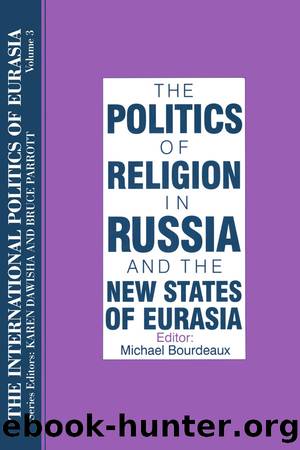
Author:S. Frederick Starr & Karen Dawisha [Starr, S. Frederick & Dawisha, Karen]
Language: eng
Format: epub
Tags: Public Policy, Political Science, General
ISBN: 9781315483801
Google: iedmDAAAQBAJ
Goodreads: 30660484
Publisher: Routledge
Published: 2016-06-16T00:00:00+00:00
8
Politics and Religion in Ukraine
In Search of a New Pluralistic Dimension
Vasyl Markus
Ukraine is presently undergoing a complex process of transition from historical domination by Eastern (Orthodox) rite national churches serving the needs of a state-controlled society to a pluralist and secular religious and social model. This contribution to the present volume intends to examine the most recent changes in the main religious bodies, that is, the Orthodox and Ukrainian Greek Catholic churches, as well as to explore the religious landscape of Ukraine by dealing with other newly established denominations and a number of older ones.
Contrary to popular belief (or the wishful thinking of some people), Ukraine is not a land of one or two national religions. Orthodoxy, which prior to 1917 could have claimed a prevailing presence and a privileged status throughout Russian-dominated Ukraine, does not now possess that exclusive position in eastern, central, or even the traditionally Orthodox areas of northwestern Ukraine. In a similar sense, the Greek Catholic Church (the Catholic community of the Ukrainian-Byzantine rite), which exclusively dominated in the Ukrainian lands held by Austria-Hungary before 1918 and then by Poland and Czechoslo-vakia, cannot today either manifest itself as or pretend to be the only religion of western Ukrainians.
Ukraine is now a nation of many religions, Christian and non-Christian (Jewish, Muslim), as well as a country in which a large segment of the population does not profess any religion. It is, in terms of religious beliefs and practices, a pluralistic society in which both the positive and negative effects of Soviet-Marxist socialization are visibly present. Therefore, Ukraine must be viewed as a modem secular state, in whose formation the religious factor historically played a significant role and where even now, in the postcommunist environment, religion cannot be underestimated.1
Also, it must be noted that certain religions in Ukraineâs history either fulfilled a positive function in nation building or tended to hamper that process. The Ukrainian case illustrates well the effects of diametrically opposed religious influences, and this aspect too will be examined.
Download
This site does not store any files on its server. We only index and link to content provided by other sites. Please contact the content providers to delete copyright contents if any and email us, we'll remove relevant links or contents immediately.
| Anthropology | Archaeology |
| Philosophy | Politics & Government |
| Social Sciences | Sociology |
| Women's Studies |
The Secret History by Donna Tartt(19092)
The Social Justice Warrior Handbook by Lisa De Pasquale(12191)
Thirteen Reasons Why by Jay Asher(8912)
This Is How You Lose Her by Junot Diaz(6889)
Weapons of Math Destruction by Cathy O'Neil(6281)
Zero to One by Peter Thiel(5802)
Beartown by Fredrik Backman(5756)
The Myth of the Strong Leader by Archie Brown(5509)
The Fire Next Time by James Baldwin(5447)
How Democracies Die by Steven Levitsky & Daniel Ziblatt(5219)
Promise Me, Dad by Joe Biden(5154)
Stone's Rules by Roger Stone(5088)
A Higher Loyalty: Truth, Lies, and Leadership by James Comey(4964)
100 Deadly Skills by Clint Emerson(4927)
Rise and Kill First by Ronen Bergman(4790)
Secrecy World by Jake Bernstein(4753)
The David Icke Guide to the Global Conspiracy (and how to end it) by David Icke(4720)
The Farm by Tom Rob Smith(4514)
The Doomsday Machine by Daniel Ellsberg(4490)
